

In today’s French renovation market, a price is never just a price. It is either a legal anchor that protects your home, your finances, and the work carried out, or it is a drifting promise with very little protection behind it.
Across France, homeowners are increasingly comparing quotes from a growing mix of operators:
- fully insured professional artisans,
- registered micro-entrepreneurs,
- handyman services,
- and informal renovation workers.
Many are experienced tradespeople. Some may even produce excellent workmanship. But in France, experience alone is not the same as legal compliance.
And that distinction matters.
At Artisan Central, we have spent years watching homeowners unknowingly compare businesses that are not operating under the same legal obligations, insurance requirements, or financial responsibilities.
The result?
- Confusion over pricing,
- disputes over unfinished work,
- invalid insurance claims,
- and professional trades are struggling to compete against operators carrying little of the legal burden they do.
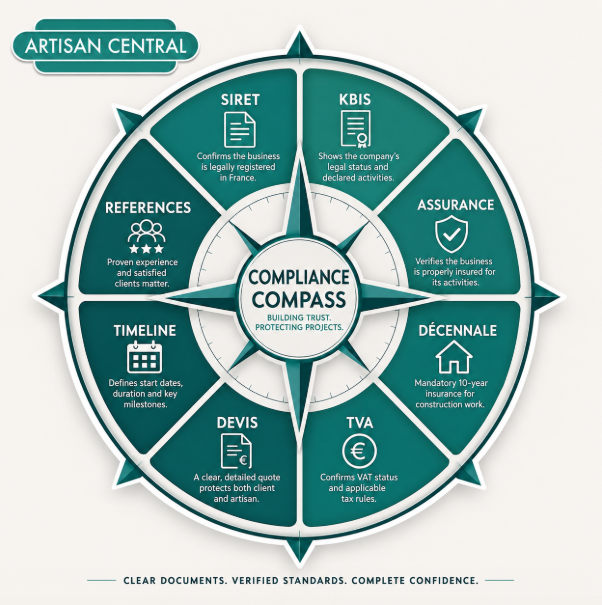
This is why we developed what we call the Compliance Compass – a practical way for homeowners to assess whether a devis reflects genuine professional accountability or simply a cheaper number on paper.
1. Is your artisan properly declared?
In France, a devis is legally required for construction or renovation works exceeding 150€.
But many homeowners make the same mistake: they assume that a SIRET number automatically means the contractor is fully qualified and insured for the work being proposed. It does not.
A SIRET confirms business registration.
It does not confirm:
- insurance scope,
- legal activity classification,
- competency for regulated works,
- or compliance with construction obligations.
This is where understanding declared business activities becomes important.
For many construction businesses in France, the Kbis extract provides a clearer picture of the activities officially registered to the company. Anyone has the right to request and obtain a company’s Kbis extract. Where applicable, additional activities can be declared through INPI and attached to the existing SIRET registration.
This matters because a business may legally exist without being properly declared or insured for the full scope of work it undertakes.
For example:
- a contractor registered primarily for maintenance or cleaning services advertises roofing, plumbing, or electrical works [or a trade that requires décennale assurance]
- but unless those activities are properly declared and aligned with their insurance coverage, the homeowner may face significant risk if problems arise later.
A professional devis should therefore align across:
- the declared business activity,
- the KBIS or registration details where applicable,
- and the insurance attestation covering the specific works being quoted.
A professional quote should clearly display:
- the business SIRET number,
- company details,
- insurance information,
- applicable TVA information,
- and sufficient detail for the proposed works to be properly identified.
The Artisan Central Perspective
Professional trades invest heavily in protecting their businesses:
- accounting systems,
- insurance,
- compliance software,
- legal declarations,
- tax obligations,
- and warranty liability.
That administrative structure is not bureaucracy for its own sake. It forms part of the protection offered to the client. A professional trade protects its customers by first protecting its business.

2. Understanding the insurance trap
One of the biggest misunderstandings in the French renovation market concerns insurance.
In France, construction insurance is activity-specific.
That means an artisan may only carry out work that falls within the activities declared to their insurer.
This is where many homeowners unknowingly expose themselves to risk.
A tradesperson may hold valid business insurance for:
- decorating,
- small maintenance,
- cleaning,
- or handyman services,
while not being insured for:
- roofing,
- structural works,
- plumbing systems,
- electrical installations,
- waterproofing,
- or extensions.
Why this matters
If a tradesperson carries out work outside their declared insurance activity:
- The insurer may refuse the claim,
- The homeowner may face expensive legal disputes,
- and future property sales can become problematic if compliant documentation is missing.
This is particularly important for works normally covered by Assurance Décennale.
The décennale is not simply “optional insurance.”
It is a legally required liability linked to specific categories of construction work.
The reality Professional Trades face
A compliant artisan prices more than labour. Their quote also reflects:
- mandatory insurance costs
- warranty liability
- accounting obligations
- TVA
- software compliance
- training
- and legal responsibility for the work carried out.
An unregulated operator may carry few or none of these obligations.
Which means homeowners are often comparing two entirely different business models, not simply two prices.
3. The anatomy of a professional devis
A properly constructed devis should be detailed, transparent, and contractually clear. Vague descriptions are often where misunderstandings begin.
Instead of:
“General renovation works”
A professional quote should ideally include:
- detailed work descriptions,
- quantities,
- unit pricing,
- material specifications,
- labour breakdowns where appropriate,
- and clearly identified TVA rates.
Professionalism is usually found in the detail. A compliant devis should also clarify:
- payment schedules,
- deposit requirements,
- estimated project duration,
- anticipated start dates,
- and how additional works or variations will be approved if the project changes during construction.
These details protect both the homeowner and the trade.
4. “Bon pour Accord”: When the devis becomes a contract
In France, once a devis is signed, it becomes a legally binding contract. This is a point many homeowners underestimate. The commonly used phrase:
“Bon pour accord et exécution des travaux” followed by signature and date, confirms acceptance of the proposed works and terms.
At that point:
- The customer commits to the agreed price,
- The artisan commits to the agreed scope of work,
- and any future amendments should ideally be documented formally.
Verbal changes during a renovation project are one of the most common causes of disputes.
A professional process protects both parties.
5. The industry is moving toward greater digital compliance
France is moving toward stronger digital reporting and invoicing obligations, with major e-invoicing reforms taking effect from 2026 onward, and those working in trades and construction will also be affected.
For professional trades, this means:
- improved traceability,
- standardised invoicing,
- and stronger compliance requirements.
Increasingly, professional artisans are adopting compliant digital systems that:
- automate legal wording,
- maintain client records,
- track invoices,
- and reduce administrative errors.
The businesses that thrive in the coming years are likely to be those combining craftsmanship with robust professional administration.
The Verdict: Compliance is not an optional extra
In difficult economic periods, the cheapest quote can sometimes become the most expensive mistake.
For homeowners, understanding compliance is no longer optional.
It is part of protecting your property, your investment, and your legal recourse if problems arise.
For professional trades, compliance is not simply paperwork.
It is evidence of accountability, legitimacy, and long-term commitment to the industry.
At Artisan Central, we believe homeowners deserve transparency, and professional artisans deserve to be recognised for the standards they maintain every day.